

The Anji Bridge, a stone arch bridge spanning the Xiao River in the south of Zhao County in Shijiazhuang, Hebei Province, is also widely known as the Zhaozhou Bridge, as Zhao County was anciently called Zhaozhou. Locals often refer to it as “Dashiqiao” (the Great Stone Bridge) to distinguish it from the nearby Yongtong Bridge, known as “Xiaoshiqiao” (the Small Stone Bridge). Originally constructed during the Sui Dynasty(581-618) under the design and supervision of master craftsman Li Chun, the bridge was later bestowed with the name “Anji” by Emperor Zhezong of the Song Dynasty, which thereafter became its formal appellation.

The Anji Bridge stands as the world’s oldest, largest-span, and most well-preserved single-arch shallow stone bridge with open spandrels. Its construction technique is remarkable for pioneering the “open-spandrel” structure in the history of bridge engineering, revealing its significant scientific research value. The bridge’s decorative carvings exhibit a vigorous and bold artistic style executed with powerful and precise craftsmanship, reflecting the robust, rigorous, and elegant stone sculpting traditions of the Sui Dynasty. The intricate ornamental patterns adorning the bridge further embody its considerable artistic value. Holding a prominent place in China’s bridge-building history, the Anji Bridge has exerted a profound influence on subsequent bridge construction worldwide.
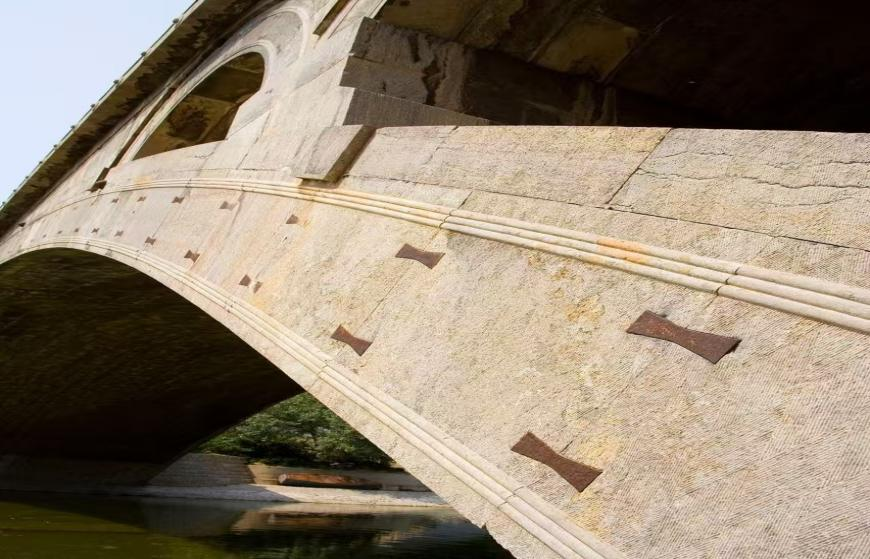
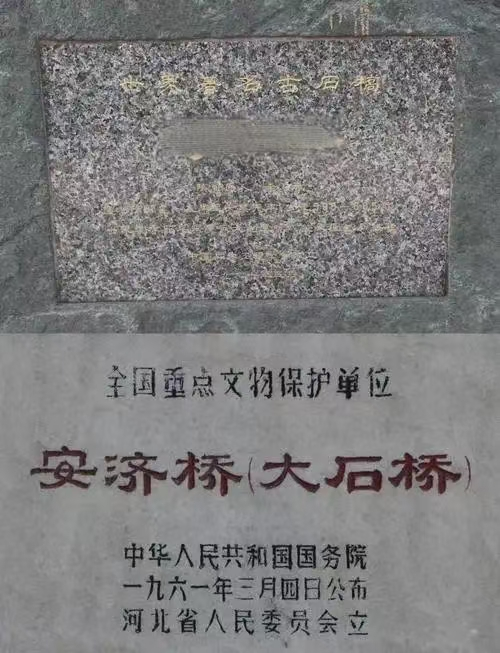
On March 4, 1961, the Anji Bridge was designated by the State Council of the People’s Republic of China as one of the first batch of Major Historical and Cultural Sites Protected at the National Level. Later, on July 22, 2023, it was recognized by the China Federation of Returned Overseas Chinese as one of the tenth group of “Chinese Overseas Chinese International Cultural Exchange Bases.” During its construction, the longitudinal parallel laying method was employed. This technique involved assembling the entire bridge using 28 independent arch rings arranged side by side along the width. Each ring was constructed separately, allowing flexible and targeted construction for every individual arch. Upon completion of one ring, the scaffolding—a temporary support structure used during construction—could be shifted to proceed with the adjacent ring. This method greatly facilitated maintenance: in the event of damage to stones in one arch ring, only the affected section required replacement without necessitating adjustments to the entire bridge structure.
First Review by Zhan Xia
Second Review by Zhang Jian
Final Review by Wang Rouhua
