

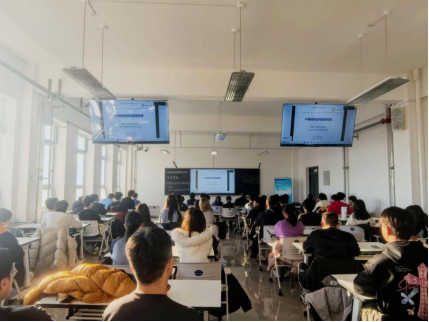
On the afternoon of November 19, 2025, Professor Yang Kun, a specially appointed professor of CIT, delivered an academic lecture titled "AI-Enabled Autonomous Driving Communication Networks" at Room A502, the Fourth Laboratory Building in the East Lake Campus. The event was presided over by Professor Pan Xin, Vice Dean of the School of Computer Technology and Engineering, and attended by relevant leaders, young and middle-aged key faculty members, as well as teachers and students from related disciplines. The lecture provided comprehensive insights and broad perspectives, offering attendees a valuable opportunity to deepen their understanding of cutting-edge developments in the integration of artificial intelligence and communication networks.
Professor Yang Kun is a Chair Professor at the University of Essex and Director of the Network Convergence Laboratory. He also holds professorial positions at Nanjing University and the University of Electronic Science and Technology of China, and has been selected as the National Distinguished Expert award. As a Fellow of the European Academy of Sciences and an IEEE Fellow, he has long been dedicated to cutting-edge research areas including wireless networks and communications, integration of communication-computing-sensing, and AI-empowered communication networks, achieving numerous internationally recognized research outcomes.
Professor Yang has secured over 50 patents across multiple countries and published more than 500 papers in leading international journals and prominent conferences. His work has been repeatedly honored with Best Paper Awards from IEEE Technical Committees and major international conferences. As a founding member and inaugural board member (2012) of IEEE InterCloud, he has actively contributed to advancing global cloud interconnection technologies.
Since 2019, Professor Yang has served as a judging expert for the GSMA GLOMO Awards at the World Mobile Congress, representing the sole academic voice on the awards panel. He also holds editorial roles as Associate Editor for several prestigious journals including WCM, TNSE, TVT, and TNB, and serves as Deputy Editor-in-Chief for IET Smart Cities. Additionally, he has been recognized as an IEEE Communications Society Distinguished Lecturer. In 2024, Professor Yang received dual honors: the IET Achievement Medal and the IEEE Technical Committee on Communications Software Technology Achievement Award, further cementing his status as an international leader in his field.
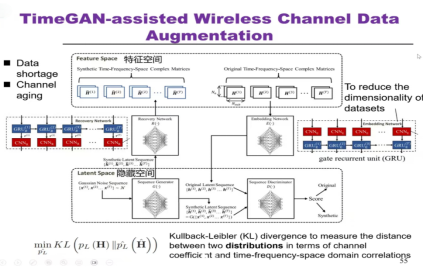
As a transformative enabling technology, artificial intelligence is increasingly becoming the core driver for achieving 6G's development goals of “higher speed, better energy efficiency, and greater intelligence.” Professor Yang systematically elaborated the latest advancements in key areas of autonomous driving communication networks, ranging from native intelligence at the physical layer and network architecture to semantic communication and the construction of digital twin networks (DTN). He emphasized that AI technology not only enhances the adaptive and decision-making capabilities of communication systems but also accelerates the realization of "autonomous driving networks" characterized by self-driven operation and self-optimization. Through his logically rigorous presentation supported by substantive case studies, Professor Yang clearly outlined the architecture and development path of AI-empowered future communication networks. His insights provided faculty and students with a more systematic and profound understanding of how 6G can intelligently respond to the diverse needs of industry scenarios.
After the lecture, Professor Yang Kun engaged in dynamic academic exchanges with attending faculty and students. This lecture significantly enhanced participants' understanding of AI-empowered communication networks, while further stimulating their research interest in the integrated development of network intelligence and AI engineering. The event served as a positive catalyst for advancing the scientific research capabilities and innovative thinking among faculty and students.
First Review by Zhang Jian
Second Review by Zhan Xia
Final Review by Wang Rouhua
